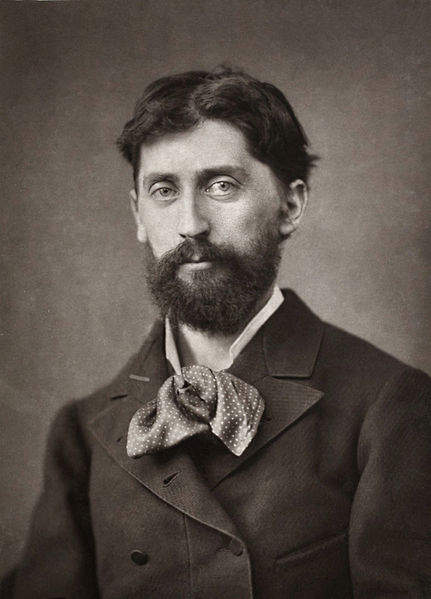
Georges Moreau de Tours was born at Ivry–sur-Seine and died at Bois-le-Roi, Seine et Marne, where he lived with his family. His work is the precious testimony of the great currents of thoughts during the second half of the 19 century in France, when Orientalism, psychiatric research and a renewal of patriotism inspired Romantic and Symbolist poets and artists. Towards the end of his life at Bois-le Roi, in the Fontainebleau Forest, he was influenced by the plein-air artists and the Impressionists. Thérèse de Champ Renaud, Moreau de Tours, his pupil, model and wife, also became a well-known artist.
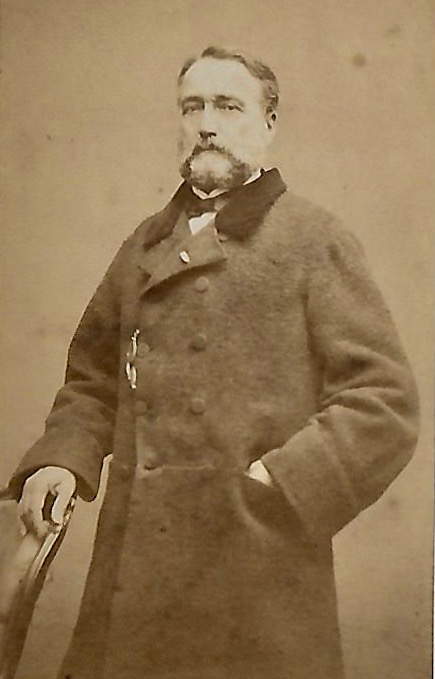
Georges Moreau de Tours was born at Ivry-sur-Seine on the 3 of April 1848 in the Maison de Santé Esquirol (named after his father’s mentor, Jean Étienne Esquirol, director of the Maison Royale de Charenton, the mental asylum). His father Jacques-joseph Moreau (1804-1884), the famous psychia‐ trist from Touraine hence the addition to his name de Tours, was the director of the clinic. His first born son, Paul Moreau de Tours, also a psychiatrist, took over the clinic after his father’s death in 1884. Georges started some law studies and gave them up to join the École Nationale et Spéciale des Beaux-Arts on October 25 1870, Section de Peinture et Sculpture, where he studied under Alexandre Cabanel (1823-1889), an academic painter of portraits and genre scenes.
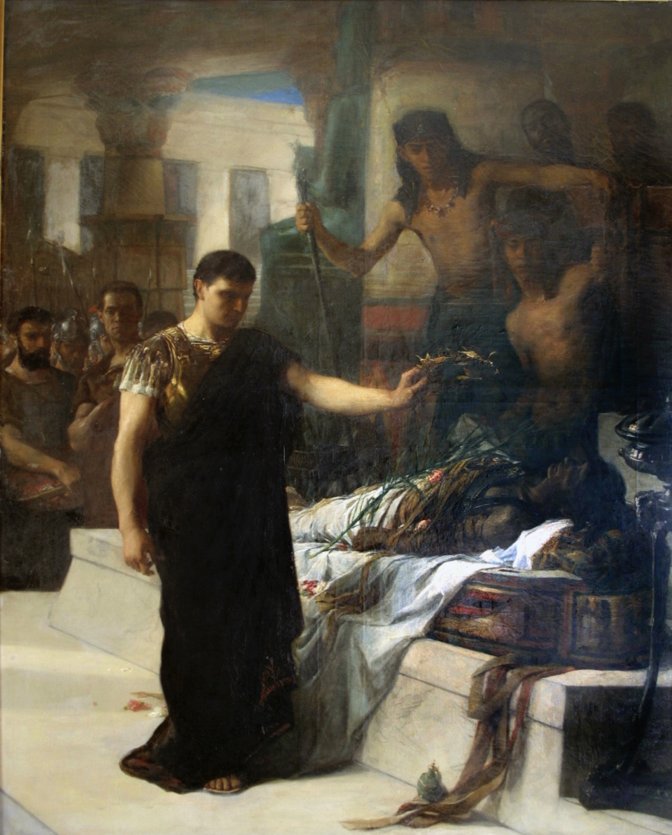
He exhibited at the Salon for the first time in 1875, and from then onward his works were regularly shown there. The painting Cléopâtre exhibited in 1875, and the painting he submitted to the Concours du Prix de Rome in 1878, Ptolémée au tombeau d’Alexandre, together with the Egypto‐ logue, 1882, now in the Musée des Beaux-Arts de Tours, are inspired by the current Orientalism and a taste for Egypt fostered on by the publication in 1858 of the novel Le Roman de la Momie by Théophile Gautier, a friend of his father, and in 1881 of Auguste Mariette’s death, who was with Champollion one of the founding fathers of Egyptology. From 1836 to 1837 Dr. Jacques-Joseph Moreau de Tours had travelled to the Near and Middle East with one of his patient and studied the clinical effects of the use of hashish on the human psyche.
In 1880 Georges Moreau de Tours won the Ville de Paris’s competition for the decoration of the Salle des Mariages in the Mairie of the 2e arrondissement with the painting Le Sacrifice à la Patrie. The sketches for the two paintings Le Mariage and La Famille, hung by its side in this room realised in 1877 by one of Victor Baltard’s pupils, are in the Petit Palais in Paris. The three paintings were put into place in 1882.
His father, Dr. Jacques Joseph Moreau de Tours, was also a great lover of art and literature. Back in Paris he had gathered around him artists, writers and other personalities in the Hôtel Pimodan, the present Hôtel de Lauzun on the Île Saint-Louis, with whom he created in 1844 Le Club des Haschischins, described by Théophile Gautier in 1848 in his eponymous essay. There he conducted a study of paranormal states under the effects of narcotics, as related by Charles Baudelaire in 1860 in a chapter of the Paradis artificiels. Jacques-Joseph Moreau de Tours was a pioneer of psychic and psychological research, which Jean-Martin Charcot (1825-1893) carried on at the hospital La Salpêtrière. They both studied the clinical effects of hypnosis and hysteria, leading to the theory of psychic trauma. France was then leader in the field and Charcot influenced Sigmund Freud, one of his pupils.
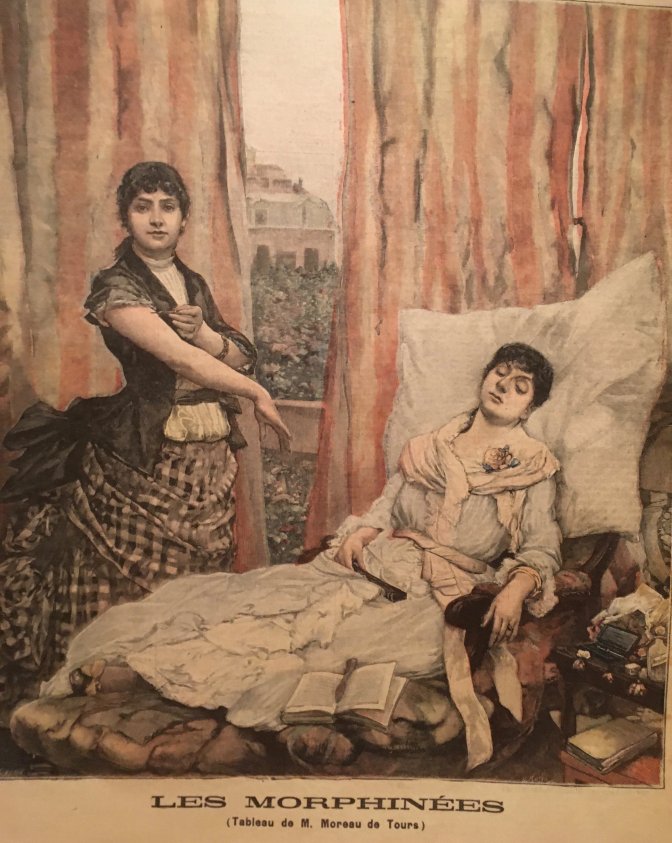
Georges Moreau de Tours explored the sub‐ ject in several of his works. He exhibited in the 1879 Salon Une extatique au XVIIIe siècle, épreuve de crucifiement , in 1885 Une stigma‐ tisée au moyen-âge, in 1890 Les Fascinés de la Charité Service du Dr. Luys. The painting Les Morphinées exhibited at the 1886 Salon and described the same year by Guy de Mau‐ passant in Chroniques, was reproduced in the Supplément Illustré du Petit Journal, 21 Feb‐ ruary 1891.
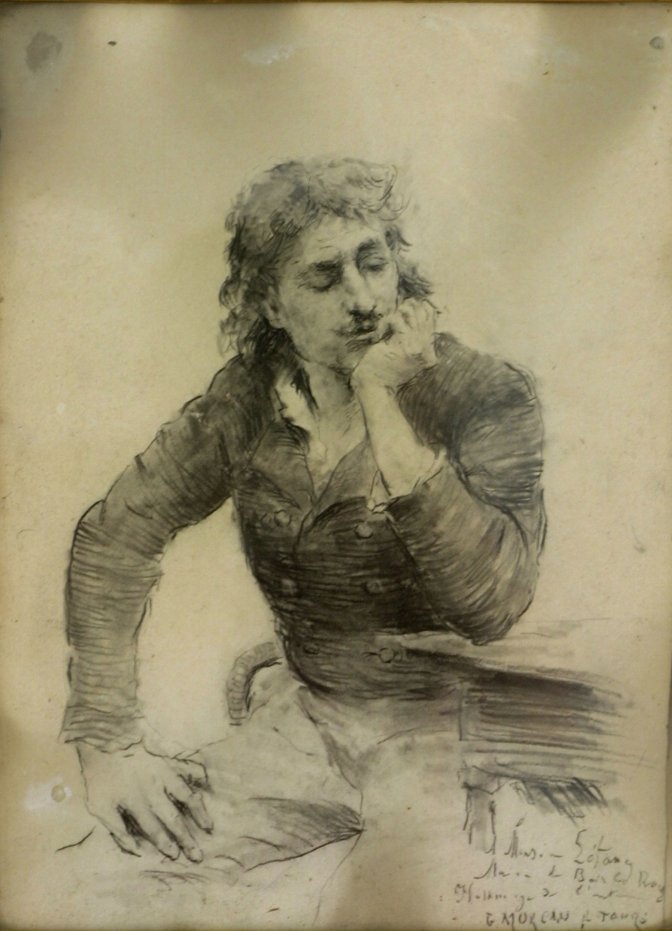
The influence of the literary circles around Moreau de Tours’s father can also be seen in several works on literary themes such as Goethe’s Faust et Marguerite, or Henrich Heine et la Muse de la Poésie, 1894. A sketch of the poet’s portrait was given by Georges Moreau de Tours to the Bois-le-Roi Mayor, Monsieur Louis Létang, a writer who held the post from 1892 till 1908, with the inscription : « À Monsieur Létang Maire de Bois le Roy
Hommage de l’auteur G. Moreau de Tours ». This sketch is now at the Mairie of Bois-le-Roi.
An important part of Georges Moreau de Tours’s work is dedicated to the celebration of Republican patriotism and of the French State. A renewal of patriotism fired on the French nation after the defeat of Sedan in 1870 and Napoléon III’s fall. In this vein the scholarly collector of Napoleonic memorabil‐ ia, Paul Marmottan (1850-1932), a contemporary of Georges Moreau de Tours, supported the nation‐ alist action of some members of the armed forces, collectors and artists who wanted to rise above the humiliation of Sedan in a celebration of the French Army at the 1889 Exposition Universelle. They launched an appeal for gifts in 1891 towards the creation of the Musée de l’Armée, and Marmottan became one of its founding members.
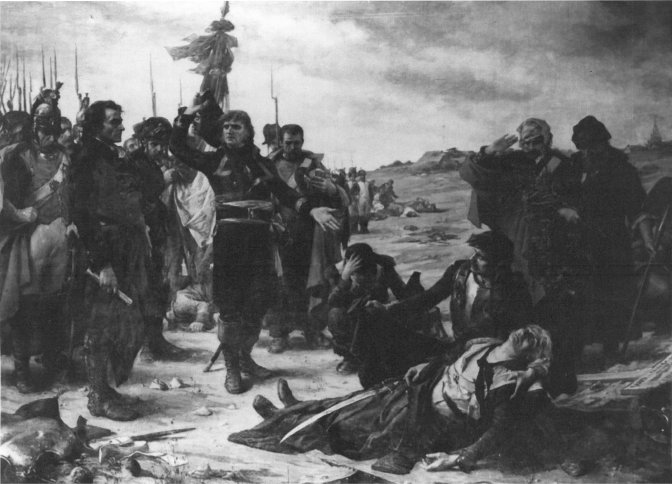
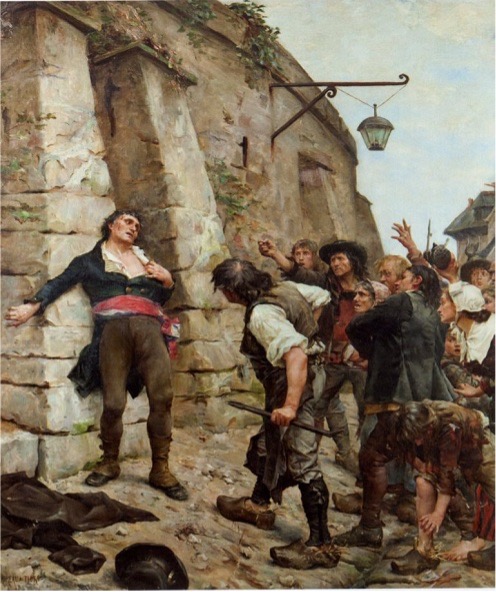
Georges Moreau de Tours exhibited four paintings at the 1889 Exposition Universelle, two of them were history paintings: La mort de Pichegru, 1886 et Le Drapeau. Assaut de Malakoff le 8 septembre 1855, bought by the State at the 1888 Salon, now in the Musée de Laval.
Georges Moreau de Tours’s ancestors had fought in the Napoleonic wars. His first cousin, Sophie Moreau, the widow of Dr. Bretonneau, friend and mentor of his father, the famous psychiatrist creator of the Club des Haschischins, Jacques-Joseph Moreau de Tours, had remarried in 1863 Justinien Nicolas, Comte Clary, Lieutenant Colonel and nephew of Désirée Clary. She was Bonaparte’s first fiancée, and wife of General Bernadotte, Prince of Pontecorvo and of the Empire, King of Sweden and Norway. Comte Clary seems to have played an important part in the painter’s life. In 1892 he presented him with the Légion d’Honneur, he was himself Commander of the Order, and in 1893 he was his witness at his wedding in Paris. In 1880 Moreau de Tours exhibited his first his‐ tory painting La Tour d’Auvergne. Premier Grenadier de France mort au champ d’honneur. It was bought by the State and hung the same year in the Musée des Beaux-Arts in Quimper. Its reproduction in chromolithography in the Petit Journal Supplément Illustré ensured its large diffusion. This heroic and patriotic theme was used by the artist in several paintings shown at the Salon:
1886 La mort de Pichegru
1888 Le drapeau : assaut de Malakoff le 8 septembre 1855, Musée de Laval
1891 La Mort du polytechnicien Vaneau, 29 juillet 1830, École Polytechnique
1892 Vive la France, exécution de G. Gombald de Dinan, sergent au 2e tirailleurs à Ingolstad, janvier 1871, Château de Dinan, illustrated in a vol‐ ume winner of a prize from the Académie Française, Histoire Générale de la Guerre Franco-Allemande, 1870-1871
1893 Au cabaret de Ramponneau, Musée de Colmar
Lazare Carnot à la bataille de Wattignies 15 octobre 1793, Musée d’Evreux
En avant, en avant ! La charge de Reichshoffen à la Bataille de Froeschwiller le 6 août 1870 (mort du colonel Franchessin) 1893 and at the 1900 Exposition Universelle Le départ du conscrit
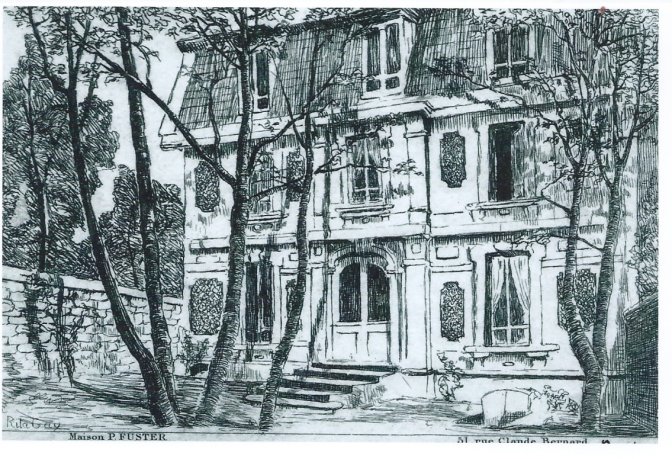
In 1889 Georges Moreau de Tours was listed as liiving at 51 rue Claude Bernard, Paris 5e in the Catalogue Général Officiel, Exposition Universelle, and in 1897 in Jules Martin’s publication, Nos peintres et sculpteurs, graveurs, dessinateurs : portraits et biographies. He would have probably moved there after his father’s death in 1884. His wedding took place at his home on the 20 of April 1893 with his Swiss model and pupil, Thérèse de Champ Renaud (1861– 1921) in presence of his doctor as he had suffered an attack of apoplexy after his mother’s death on March 25 1893. Their three illegitimate daughters, now recognized, were born there: Jacqueline in 1886, Georgette in 1887, Sophie Germaine in 1890 – she died in December 1893 – as well as their son René born in 1895
Thérèse had also studied at the Beaux-Arts with Cabanel and she was Georges Moreau de Tours’s only pupil. She painted landscapes, genre scenes in the open air, and in emulation of her husband’s work, some history paintings. She exhibited at the Salon from 1885 till 1893, and her name appears under Georges Moreau de Tours’s signature in 1891 on a painting depicting Le Maire de Rennes dated 1887. It was reproduced in the Supplément Illustré du Petit Journal of February 7 1891 with the description « Tableau fameux de Mme Moreau de Tours ». This painting was bought in 2012 par le Musée de Bretagne in Rennes.
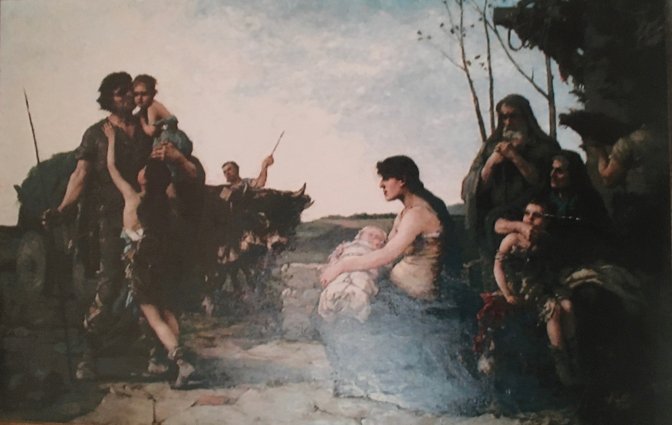
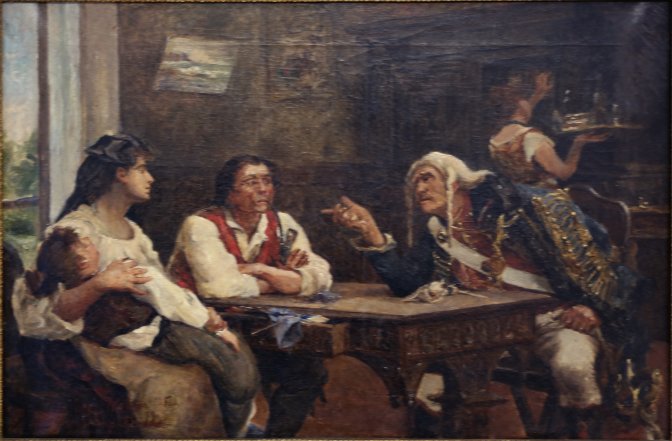
Le Retour, a painting depicting a Republican soldier’s home return from the army, probably in Alsace for the regional black satin bow at the back of the mother’s hair holding her child in her arms, was bequeathed to the Mairie of Bois-le-Roi in 2018.
In 1891 the review L’Illustration, SALON 1893 reproduced a seascape, Souvenir du Tréport, Mme G. MOREAU DE TOURS, née DE CHAMP-RENAUD. The same year Le Petit Journal, Supplément Illustré honored Georges Moreau de Tours and his wife Thérèse in illus‐
Le Maire de Rennes oil on canvas, Thérèse Moreau de Tours, née Thérèse de Champ Renaud, 1887, Musée de Bretagne, Rennes illustrating Le Maire de Rennes on January 17 1891, on February 7 Jeune Mère, Tableau de Mme de CHAMP-RENAUD, then on February 21 Les Morphinées, Tableau de M. MOREAU DE TOURS, and finally on August 22 1891, La Petite Patriote, Tableau de Mme de CHAMP-RENAUD
In 1900 in the Paris Hachette Annuaire illustré, Georges Moreau de Tours is listed as resident in Bois-le-Roi under Adresses Mondaineswhere he had bought a property probably in 1895. In 1871 a colony of artists, writers and
composers had settled there fleeing from the chaos of the Siege of Paris and of the Commune. Moreau de Tours’s father had also been a friend of Dr. Claudius Bureaud-Riofrey, Mayor of Bois-le-Roi from 1876 to 1881. During the census of 1900-1902, the painter’s family is listed after his death in 1901 at Bois-le-Roi, 224 avenue de la Gare, nowadays 79 avenue Foch. At this address were mentioned his widow Thérèse, their three children born in Paris : Jacqueline, fifteen years old, Georgette, thirteen, et René, six years old, together with a domestic.
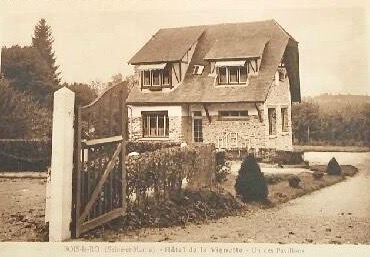
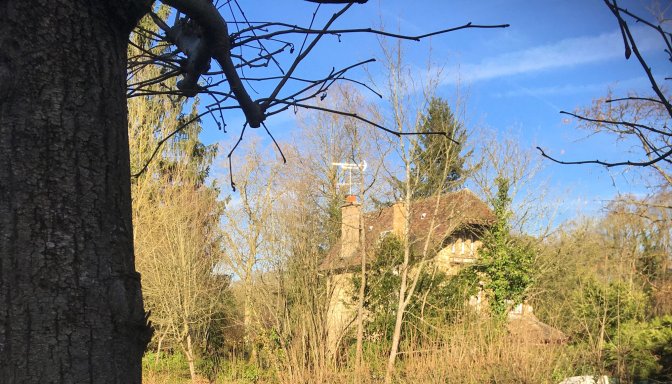
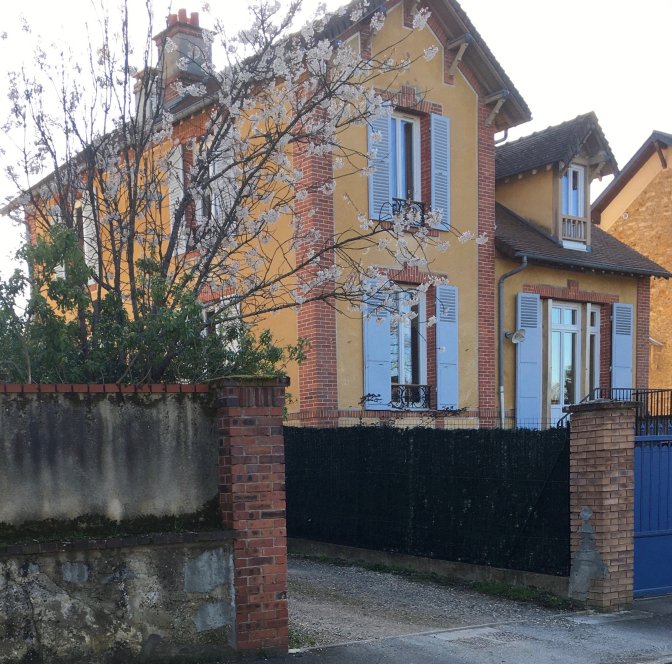
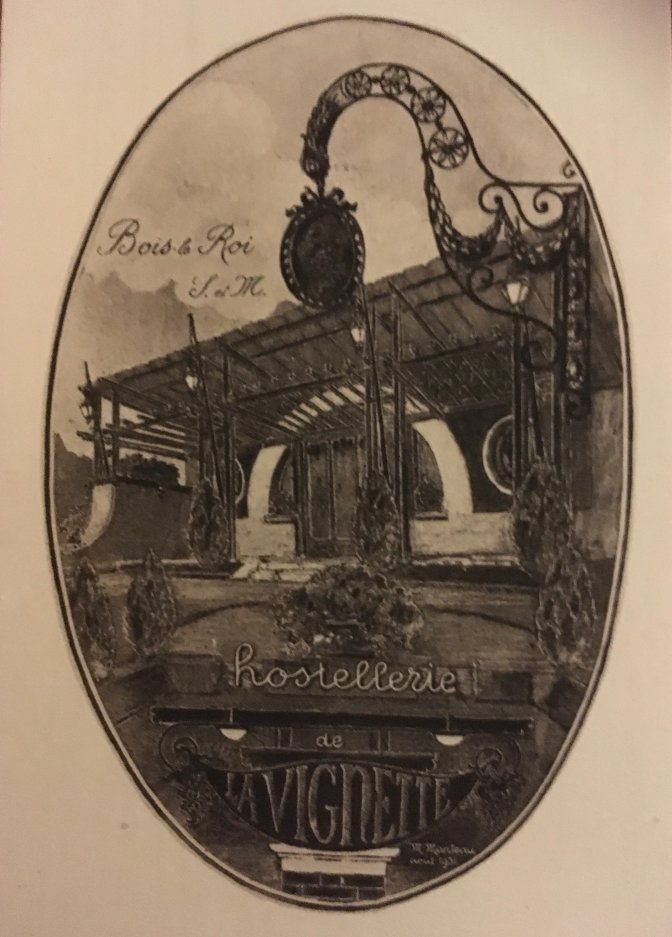
His grand-daughter Simonne Hennape, who died in 2003, recalled their residence at the place called La Vignette, listed under the name Moreau de Tours on the 1904 cadastre on both sides of the Av‐ enue de la Gare. The family owned several houses, one at number 77 on the actual avenue Foch, formerly 222 avenue de la Gare, where Thérèse’s mother, now remarried to Pierre Monfray, lived. They were both registered there from 1901 till 1911. There was another house at number 79, formerly 224 avenue de la Gare, where Thérèse was mentioned as a painter in the 1906 census with her two daughters: Jacqueline, a violin teacher, Georgette a pianist, and her son René together with a house‐ keeper. René went into business with his brother-in-law Charles Louis Lesot de la Panneterie, so called de la Cressonnière, an actor on stage and in silent films, the husband of his sister Jacqueline, to transform the property 79 avenue Foch in a hostelry called La Grande Vignette. The Visitor’s Book
The artist’s studio was situated opposite the house on the other side of the street, 64 avenue Foch. It became a ballroom where dances and theatrical performances where held until the sixties, when it was demolished. An annexe of the Grande Vignette, La Petite Vignette, had been built beside it 62 avenue Foch.
The artist’s studio was situated opposite the house on the other side of the street, 64 avenue Foch. It became a ballroom where dances and theatrical performances where held until the sixties, when it was demolished. An annexe of the Grande Vignette, La Petite Vignette, had been built beside it 62 avenue Foch. works of smaller size and different subjects. He now illustrated literary, poetical and musi‐ cal themes, painted mostly plein-air scenes depicting Thérèse and his children, in particu‐ lar the last one, his son René, landscapes and seascapes. These paintings show the clear influence of the School of Barbizon, a village nearby in the Fontainebleau Forest. Following the example of Corot and of John Constable, who had exhibited at the Paris Salon in 1824,
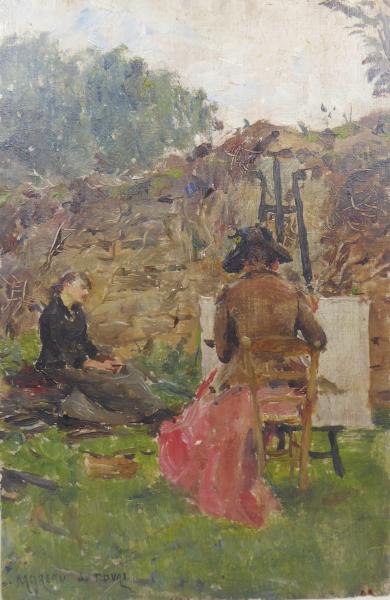
These paintings show the influence of painters from the Barbizon School, a nearby village in the Forest of Fontainebleau where, following the example of Corot and the English painter, the master landscape painter John Constable, who exhibited in Paris at the 1824 Salon, a succession of artists applied themselves from 1825 to 1875 to “painting outdoors and from nature.” This was made possible by the commercialization of oil paint in tubes, although Constable’s painting, which received a gold medal from Charles X at the Salon, The Haywain, 1821, was painted in the studio based on studies made outdoors, following the model of historical paintings, whose large dimensions it also assumes. The original title of the work was Landscape, Noon, indicating that the painter had initially conceived it in the style of the landscapes of Claude Lorrain and Dutch landscape masters such as Salomon and Jacob van Ruysdael. Georges Moreau de Tours seems to have spent happy days in Bois-le-Roi with his close-knit family, where love and harmony reigned in a tender complicity between the spouses, both absorbed in a work that had always united them despite the obstacles to their union. He depicts this simple domestic happiness in bucolic settings with a brighter and more fluid palette, such as in Thérèse Painting in the Garden at Bois-Le-Roi.
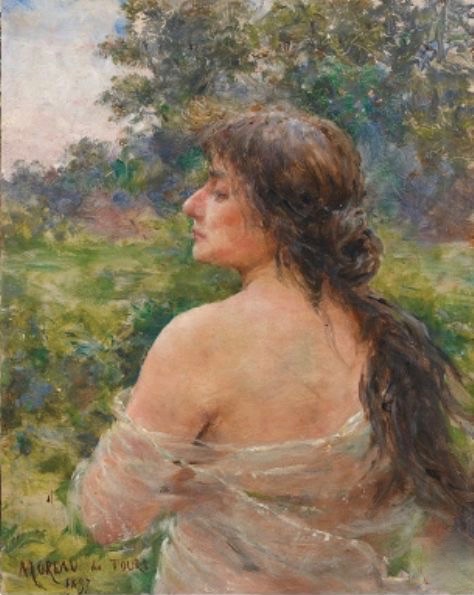
Thérèse was his only model and his only pupil, and although at the beginning of their life together before their marriage he depicted her in the academic style of allegorical scenes such as Le Sacrifice à la Patrie (Sacrifice to the Fatherland), mythological or religious scenes, his later style shows a more flexible, luminous and sensual style, close to the palette and technique of the Impressionists. This is evident in the moving Portrait of Thérèse Seen from Behind, 1897, in which he expresses with great sensitivity all his love for the sensual and radiant beauty of his wife. Thérèse emulated her husband’s style and the various genres in which he worked, such as The Battle of the Alma. Zouave Recovering His Regiment’s Flag from the Enemy, 1909. So much so that both their signatures can appear on the same painting, such as The Mayor of Rennes in 1887, reproduced in the Supplément Illustré du Petit Journal on 7 February 1891 under the description Famous painting by M Moreau de Tours. Or works can be attributed indiscriminately to the master or the pupil, the husband or the wife, such as Jeune Mère (Young Mother), 1891, perhaps suggesting a possible collaboration on certain canvases. Moreover, after the death of Georges Moreau de Tours, Thérèse depicted herself in her own paintings, following her husband’s style, his loving gaze still alive and resting on her in her art. Her output was as prolific as that of Georges Moreau de Tours, and she participated in numerous exhibitions where she is mentioned indiscriminately under the names Thérèse Champrenaud, Thérèse Champ Renaud, Thérèse de Champ Renaud, or Thérèse Moreau de Tours.
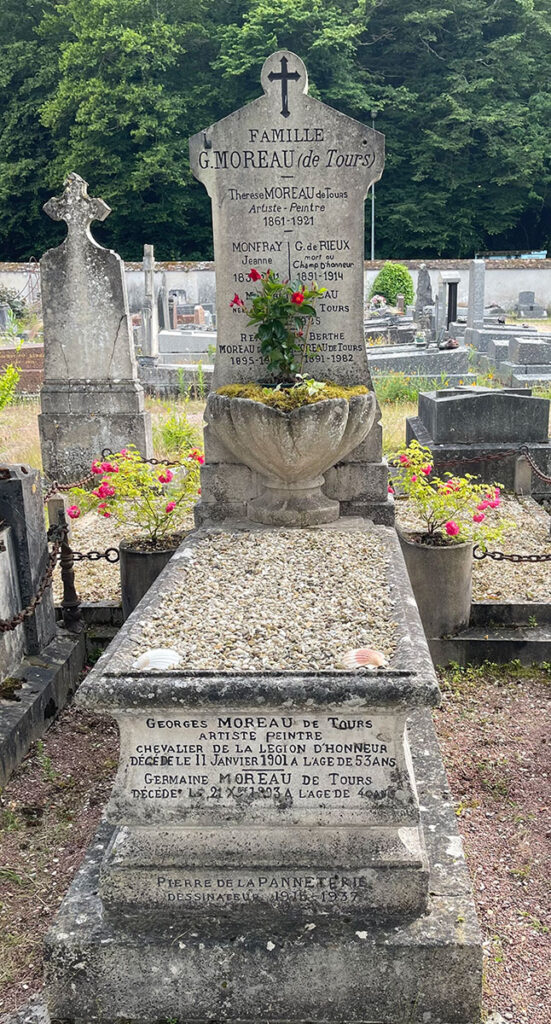
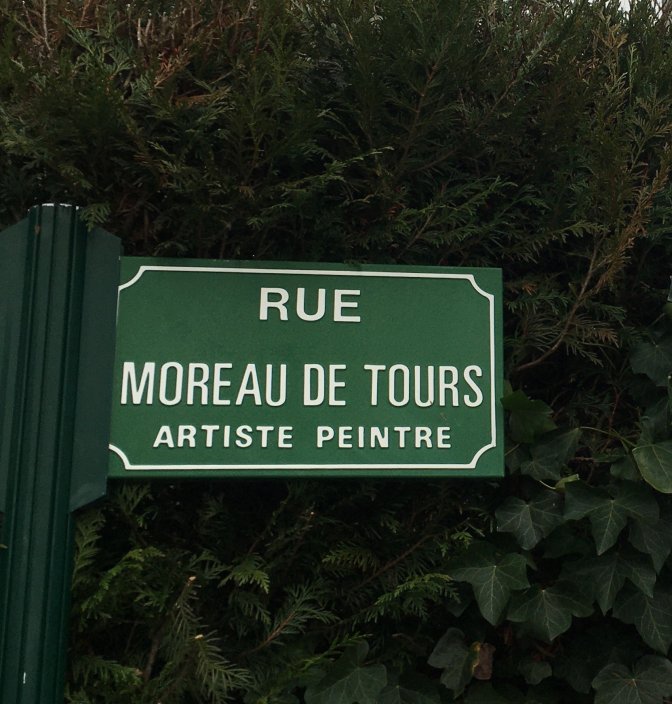
Georges Moreau de Tours died on 11 January 1901 in Bois-le-Roi. He is buried alongside Thérèse, who died in Paris in 1921, in the family vault at the Bois-le-Roi cemetery, which also houses their children and spouses, and close members of their family, including Thérèse’s mother, Jeanne Monfray, née Hassler, widow of Louis Champ Renaud, who died in Bois-le-Roi in 1911. Some of the descendants of Georges and Thérèse Moreau de Tours still live in the town. Rue de Longuives in Bois-le-Roi was renamed Rue Moreau de Tours in 1930 after the painting Ptolemy at Alexander’s Tomb was donated to the town by their son René in 1929.
© Monique Riccardi-Cubitt
All rights reserved.
© Copyright 2025 Monique Riccardi-Cubitt
Webmaster : Toussain Marthoud Président de l’agence Transparence Digitale