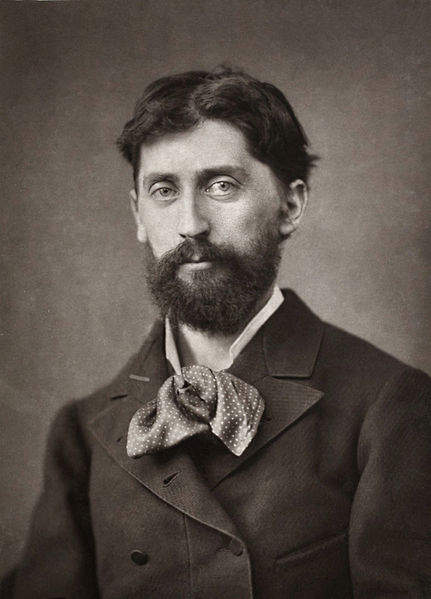
Jacques Joseph MOREAU DE TOURS was ‘an uncontested and indisputable master of modern psychiatry’ according to Dr. Henri Ey, and Pr. Henri Baruk of the Académie de Médecine had designated him as father of the psychopharmacology in creating the Société Moreau de Tours. MOREAU DE TOURS owes his fame to two books : Du hachisch et de l’aliénation mentale published in 1845, and La psychologie morbide in 1859. On his return from a Middle East tour, he created in Paris in 1841 with Dr. Aubert-Roche, Head Physician to the Compagnie du Canal de Suez and Director of the Department of Contagious Diseases, a Société Orientale supported by many famous personalities in political and literary circles. MOREAU DE TOURS had an artistic nature,‘ he loved art in all its aspects; he enjoyed conversing with literati and artists’ wrote Antoine Ritti, his first biographer, It is then that he truly started his first self-experiments with the hashish, used as a remedy against the plague during Bonaparte’s Egyptian campaign. He was in search of ‘a general theory of mental alienation based on the analogy between the state of dreaming and insanity, and on the identity of a natural state of madness and of the madness created by cannabis. ‘
In 1845 he carried on his study on the origins of Creative Genius at the Club des Haschischins at the hotel de Lauzun where the Romantic intelligentsia gathered, among which Théophile Gautier who described these soirées named fantasia in 1846 in an article for La Revue des deux Mondes entitled Le Club des Hachichins. Baudelaire was critical in Les Paradis artificiels, comparing the hashish to wine, he condemned it thus: ‘wine elates the will, hashish annihilates it.’ ‘With the publication of his Psychologie morbide in 1859 Moreau de Tours was yet again to astonish his contemporaries…The link Genius/madness was commonplace since Antiquity, but no one had yet proposed to make enter the pathological element to this extent and in solely referring to modern science born in the 19 century, which Moreau called morbid psychology… Above all no one had yet dared make a link between Genius and idiocy.’ wrote Dr. Luauté, author of the biography Les Moreau de Tours. His provocative propositions ‘ Genius is only a neurosis… brought him many criticisms, but the current studies on the concept of the creativity of artists, writers or scientists, with the now fully recognized favourable effect of mood disorders, (even of a bipolar illness) follow on the path he had first traced’ concludes Dr. Luauté. (See his article on the site under Jacques Joseph Moreau de Tours)
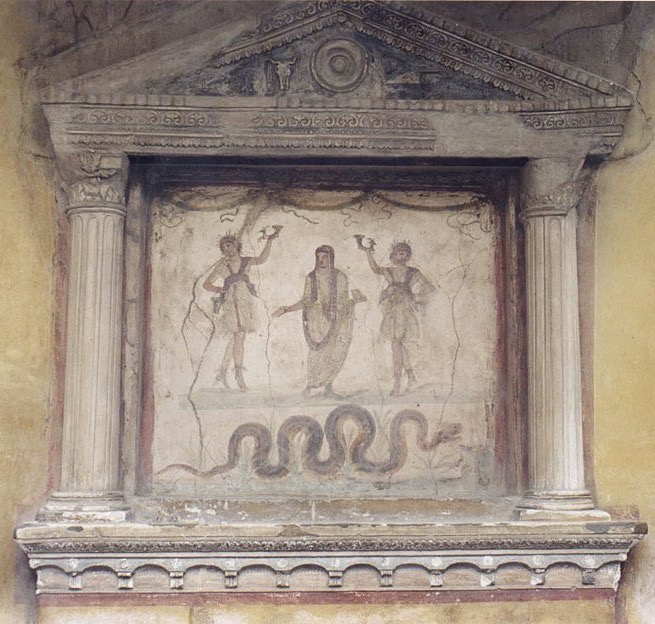
The concept of Genius, known to the Greeks, goes back to Antiquity. Its latin roots, genius, described in Roman times the individual representation of a divine nature in man, places and objects, or in abstract mode, in all human enterprises. ‘Thus man, following the dictates of his heart, venerated something higher and more divine than he could find in his own limited
individuality, and brought to ‘’this great unknown of himself’ offerings
as a god; thus compensating by veneration for the indistinct knowledge of his divine origin.’ stated Mary Ann Dwight in Grecian and Roman Mythology in 1860. The etymology of the word itself refers to lineage, here of divine origin. Thus, every human being has his own genius, like a guardian angel, not be offended, on the other hand the Lares and the Penates were tutelary deities protecting places and homes. Saint Augustin in the 6th century refers to the Roman tradition in The City of God against the Pagans. ’Varro says that a ‘genius’ is the rational soul of each man … and that the soul of the world itself is a universal ‘genius’, and that this is what they call Jupiter.’
This presupposition of the divine origin of genius was carried on by Renaissance humanism through the emulation of Greco-Roman classicism and the awareness of the enigma of man’s place in Nature, and of his relationship with Nature. At the same time the artists were given a new transcendental status, yet they remained aware of this mystery, Michelangelo, and later Rubens and Bernini, used to say that they were only ‘an instrument in God’s Hand’. The dark side of Genius was already acknowledged in the Melancholic type, as defined by the theory of the Four Humours by the Ancient Greeks and the Arabs, and taken on by Carl Jung. These are the artists and poets’ souls born under Saturn, as explored by Rudolf and Margot Wittkower at the Warburg Institute in London in their pioneering volume in 1963, Born under Saturn. The Character and Conduct of Artists, and Erwin Panofsky in collaboration with Raymond Klibansky and Fritz Saxl, Saturn and Melancholy: Studies in the History of Natural Philosophy, Religion, and Art in 1964. Verlaine had inscribed himself in this line in naming his first collection of poems in 1866 Poèmes saturniens, a title no doubt inspired by Dûrer’s engraving in 1514, Melancolia, he then owned.
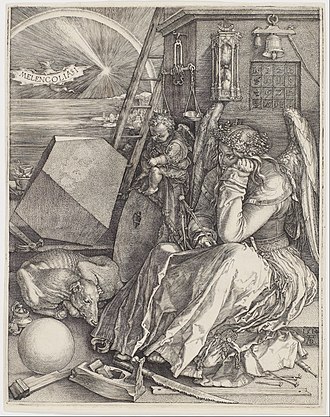
The German master has illustrated the Renaissance philosophical concept of Melancholy to be found in artists ruled by imagination. Scholars are under the sign of Reason, while mystics and theologians gravitate in the last spiritual stages towards transcendence. The engraving abounds in esoteric and alchemical symbols. The artist has been able to free in his art the Genius depicted by Dûrer in the antique manner of a winged child, here imprisoned under the ladder itself burdened down by an enormous weight. He has thus reached the Elysian summits in getting down to work in this world, the mystery of which is inscribed in the magical square where the sacred numbers add up vertically and horizontally to 34, as Plato had stated in his Academy: Let None but Geometers Enter Here, in praise of abstract thought. In shaking off the torpor of Melancholy and the dark shadows of the night birds, such as the bat hovering in the nocturnal sky, the artist has taken on his tools spread on the floor. He is now flying on his own wings and can assume his own creativity, which will open to him the doors of power and wealth, whose key and purse hung symbolically at the belt of the allegorical feminine figure.
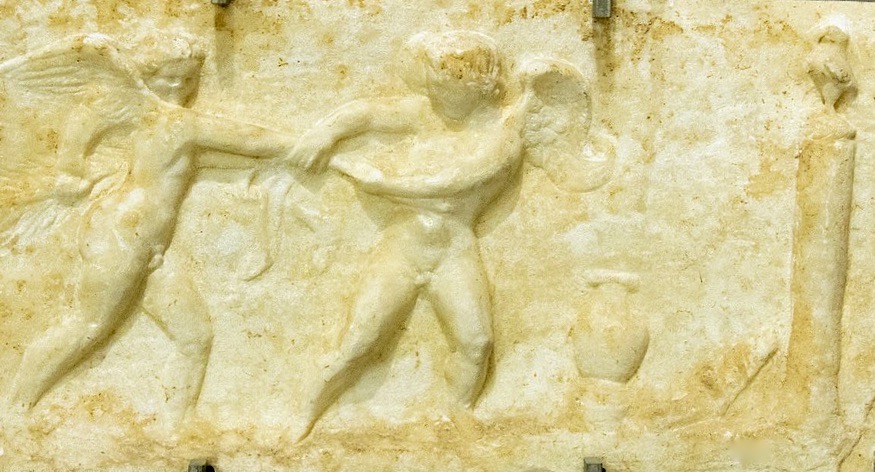
In Eros, according to Plato of all the gods ‘the most ancient, the most august, the most able to make man virtuous and happy during his life and after his death’ rests a mystery. He is born twice from Aphrodite his mother with a twin, Anteros, altogether his opposite and his complement, even if both participate from the attraction and equilibrium of the duality between the feminine and the masculine principle. Their manifestation is linked with the mystery of the libido of man awakened in spirit, and revealed to himself in his power of creation. Eros stands for profane emotional sexual love with another, Anteros represents exalted and sublimated love in oneself, love made sacred in abstinence, the father and protector of all the arts in human creativity. Titian illustrated this dichotomy in 1514 in his painting Amor Sacro, Amor Profano, now in the Galleria Borghese in Rome. Sacred love is depicted as a nymph whose nakedness is stripped from all the frivolous trappings of worldly life adorning Profane love, she is the symbol of spiritual life. It was Anteros under the guise of Laura who inspired Petrarch’s sonnets, and in Dante’s Divine Comedy he appears as Beatrice, the feminine archetype guiding the poet to Paradise. The Italian writer Roberto Calasso analysed in 2005 the power of the feminine principle, the Ninfa as guide and source of inspiration in an article: La follia che viene dalle Ninfe The Madness which comes from the Nymphs. It is a divine madness revealed under a triple aspect: the Nymph the incarnation of Beauty in an ideal and fatal feminine form, the Source as the symbol of emotions, and the Serpent, the Divine Fire of Knowledge stolen by Prometheus under the influence of Anteros. For the awakened Indian yogi it is the Kundalini, for the Ancient Egyptians it stood for the cobra Naja, the Uraeus of Ra, the solar god whose symbol crowned the pharaoh, an initiated priest. If the soul is not pure enough in the love of God and of others, this fiery energy can lead to madness in the ordeal of the Mysterium tremendum according to the German theologian Rudolf Otto. It is the madness of the Black night of the soul described by the 16th century Spanish mystic St. John of the Cross in his poem. The soul must undergo this great illusion to be initiated and accede to the light of Knowledge and the contemplation of the Ineffable. Man acquires then the power of the demiurge to transform the world, it is the power of the poet philosopher, of the illuminated mystic, or of the visionary artist according to Vassily Kandinsky’s The Spiritual in Art in 1910.
The Russian Jewish artist Christian Boltanski stated: At the root of every artist’s life there is a trauma. It is often the suffering of the absence of a loved one which opens the doors of perception and creativity. Dominique de Villepin outlines it in 2003 in a homage to his elder brother’s passing away in his book Éloge des Voleurs de Feu ‘…to refuse destiny and vertigo, to exorcize the scream of fear within us…Yes poetry to go on living…I dream of words to enlighten, words to save.’ The ecstatic experience of the Voleurs de Feu, Robbers of the Divine Fire, in the creative act has for counterparty the suffering of the human soul torn apart by universal duality as in the myth of Prometheus tormented by his emotions. ‘The souls fly to Heaven on two wings, if I understand it well, they are Justice and Wisdom; Socrates teaches us in the Phaedra that one can acquire those virtues in following the two paths of Philosophy: the path of Action and the path of Contemplation. In recovering these two wings, the soul leaves the body under their power, filled with Divine grace, she seeks of all her strength to reach Heaven where she is attracted. Plato names this invincible call the Divine Frenzy.’ The Neoplatonic poet and philosopher Marsilio Ficino, founder of Cosimo de’ Medici’s Academy in Florence, explains it thus in his Seventh Letter, De Divino Furore, in 1457. In reaching Higher Knowledge the body is seized by a state of divine exaltation. It is this state of drunkenness described by Baudelaire in Les petits poèmes en prose, Short poems in prose : ‘One must always be drunk, that is all, it is the only question…But of what? Of wine, of poetry or of virtue as you please, but be drunk.’ He defines it as Genius: ‘ There are times when man wakes up with a young and vigorous genius…this exceptional state of the spirit and the senses…which I can call paradisiac without exaggeration …often this marvel, this kind of prodigy occurs as if under the effect of a higher invisible power, outside man himself…This acuity of thinking, this enthusiasm of the senses and the spirit must have in all times appeared to man as the first of all worldly possessions’. As expressed by the Sufi mystic Djalâl ad-Dîn Rûmî in the 13th century:
What should I do, Ô, You subjected to God? I do not know.
I am neither a Christian, nor a Jew, nor a Zoroastrian, nor a Muslim;
I am not from the East, nor from the West, nor from the earth nor from the sea…
I am not from this world, nor from the other,
Nor from Heaven, nor from Hell;
…I come from the Soul of souls.
I have banished duality, and I live the two worlds as a single one;
He is the first, he is the last, he is the inner, he is the outer,
The cup of love has given me divine ecstasy.
Ô Sun of Tabriz, I am so exhilarated, here in this world,
Yes, I have nothing else to show but ecstasy and exaltation.
Duality divides and torments the human soul in some terrible conflicts as described by Rimbaud: ‘The spiritual fight is as brutal as men’s battle. Very hard night! Dry blood steams off my face.’ In the act of creation, the opposites are reconciled in a Dionysiac ecstasy risen from the depths of the soul and transporting it. Because man is infinitely perfectible, as stated by the poet and philosopher Pico de la Mirandola, in The Oration on the Dignity of Man in 1486, translated by Marguerite Yourcenar in L’Œuvre au Noir, The Abyss : ‘ I made you neither of heavens nor of the earth, mortal or immortal, so that you from your own free will achieve your own distinctive form in the manner of a talented painter or a skilful sculptor.’ Antoine de Saint-Exupéry reiterates it in Terre des hommes, Wind, Sand and Stars, in 1939 : ‘…Only Spirit if it breathes on the clay can create Man.’
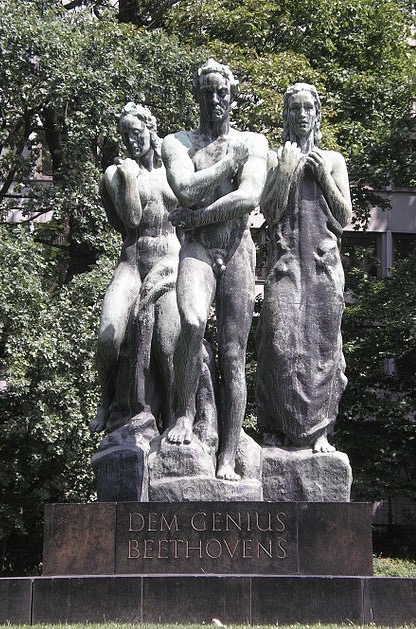
And for Spirit to breathe on the human soul some conditions must be met. ‘Poetry is the spontaneous overflow of powerful feelings : it takes its origin from emotion recollected in tranquillity’ wrote William Wordsworth in Lyrical Ballads in 1800. It is thus for all creative acts, such as music. The monument to Beethoven’s genius in Frankfurt by Georg Kolbe in 1939 illustrates the poet’s words. The composer is flanked by two allegorical feminine figures Sinnende, Contemplation and Rufende, Summon. 4 Dallas Kenmare in her book The nature of Genius in 1960, under the title The ‘Unknown Eros’ quoted Nicolas Berdyaev’s 1914 essay, The meaning of the Creative Act. An essay on the Justification of Man: ‘The life of genius is not a ‘natural’ life…The new man is above all a man of transfigured sex who has restored in himself the androgynous image and likeness of God.’ He further elaborates: ‘Mans’s dignity rests on the presupposition of the existence of God. It is the very essence of all vital humanist dialectics… Man as such can only be so if he is a free spirit reflecting the Supreme Being’. The French Académicien Henri Brémond in 1925 in Prière et Poésie, Prayer and Poetry, spoke of the ‘Mystery of Poetry’, it is the mystery of all human creative act under the influence of its genius, Antéros.
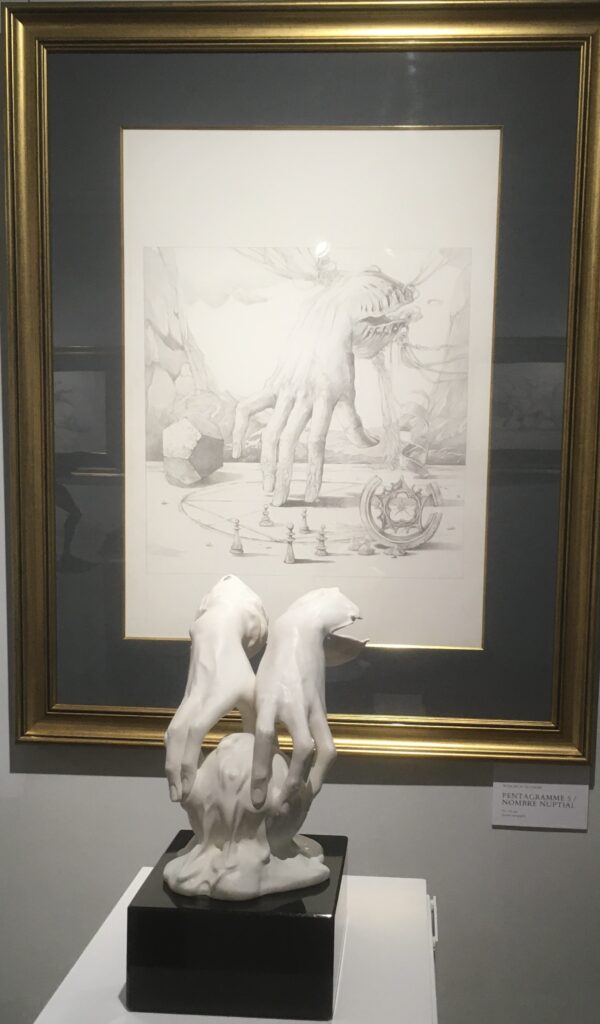
The clinical, as well as philosophical and artistic study of this mystery perceived by Jacques Joseph MOREAU DE TOURS, was conducted by the German psychiatrist and art historian Hans Prinzhorn, who published in 1922 The Expression of madness, and whose collection of psychopathological art is now exhibited at the Psychiatric Hospital in Heidelberg University.
Prinzhorn’s research on the subject influenced Surrealist artists and poets, Paul Klee et Max Ernst, and was determining from 1945 onwards in the creation of the French artist Jean Dubuffet’s Art Brut collection. To build it up Dubuffet worked in collaboration with French writers and poets such as Paul Éluard and Raymond Queneau, the collection is now kept in the château of Beaulieu in Lausanne. The title in German and English Artistry of the Mentally Ill : A contribution to the psychology and psychopathology of configuration, describes Prinzhorn’s original research. His concept of Gestaltung, a theory of the formation of forms in a significant structure becomes a universal principle governing the whole universe at a cosmic, akin to Pythagoras’s mathematical precepts of the ‘music of the spheres’ and Plato’s geometrical concepts. This ‘primary process’ arises from ‘universally human ideas…In each individual person there exist in a latent state a series of functions which under certain conditions would necessarily bring about, always and everywhere, some processes of the same nature.’ ‘The life experience of the individual’ is less important than ‘ the supra-individual components of the Gestaltung’ . They rest on aesthetics, and no particular form belongs exclusively to madness. The intense rhythm and extraordinary energy conveyed by some schizophrenics’ works, creating a feeling of ‘strange disquiet’ can also be found in primitive art, and in other forms of art in the course of centuries, using symbolism and magical signs in religious, philosophical, or erotic representations. ‘L’art des fous’ as it was then perceived expresses the universality of Creative Genius, as can be seen in Wojciech Siudmak’s visionary fantastic hyper-realist art.
Monique Riccardi Cubitt
©All rights reserved
© Copyright 2025 Monique Riccardi-Cubitt
Webmaster : Toussain Marthoud Président de l’agence Transparence Digitale